The unit was running non stop and never quite reaching its setting. He weighed in the charge properly after the repair instead of guessing on gauge pressure, which the last firm did not bother with.
Alaric M.2026-06-27
Independent Sub-Zero specialists · Fleming Island, Clay County
Monday – Friday 8:00am – 6:00pm Call (904) 201-3304
The largest master-planned community on Fleming Island, and a whole generation of built-in refrigerators that went in with the houses and are still running.
Eagle Harbor is the master-planned end of Fleming Island — golf, the swim park, a street plan that was drawn all at once, and houses that went up in phases rather than one at a time. For a refrigeration shop that last point is the most useful thing about the neighbourhood, because it means the appliances came in waves too.
When a builder finishes a phase, every kitchen in it gets its equipment inside a year or two of every other kitchen. Twenty-five years later that produces a pattern we see nowhere else in Clay County: a run of calls from the same few streets, in the same season, for the same wear items. Door closers that have stopped pulling the last inch. Condenser fans that have become audible from the next room. Control boards on their second life.
None of that is a defect. It is a cohort of hard-working appliances arriving at the same point on the curve at the same time. It does mean that when a neighbour tells you their built-in did exactly what yours is doing, they are probably right, and it means we usually know which parts to bring.
Eagle Harbor kitchens came from a limited number of plans, so the cabinet opening around a built-in tends to be square, to specification and repeatable. That matters more than it sounds. Pulling a full-height built-in out on its rollers is the riskiest ten minutes of most visits, and in a house where the opening was framed properly and the flooring stops at the toe kick rather than running under it, that ten minutes is uneventful.
Where it stops being predictable is after a remodel. Plenty of these kitchens have been redone once by now, and the two changes that cause us trouble are a new floor laid over the old one, which steals height from the opening, and a reworked island that has moved into the door swing. We measure before anything moves.
It is the fair question to ask about a cabinet of this age, and the arithmetic for a built-in is not the arithmetic for a freestanding refrigerator.
A built-in was installed as part of the cabinetry. Its opening was framed to it, its panels were made for it, and the trim, the toe kick and often the flooring were finished around it. Replacing it is rarely just an appliance purchase: a current unit may not match the old opening in height or depth, panels seldom transfer, and the work can reach into the counter run. That is why a repair that would be marginal on a freestanding unit is frequently the sensible choice here.
What tips it the other way is the sealed system. A compressor or an evaporator failure on a cabinet already at the end of its service life, with other components of the same age behind it, is worth a hard look before spending. Wear parts — fans, thermistors, door closers, gaskets, hinge hardware, most control boards for these platforms — are a different case entirely and usually worth doing.
We give you the finding and the number in writing and let you decide. If the honest answer is that the repair costs more than the cabinet is worth to you, you will hear that from us rather than have to work it out afterwards.
Storms, mostly. Northeast Florida runs something in the order of sixty-eight thunderstorm days a year, and a built-in that has gone unresponsive or blank after a bad afternoon is a familiar call here. Surge protection on the refrigerator circuit is cheap and it is not standard in houses of this vintage.
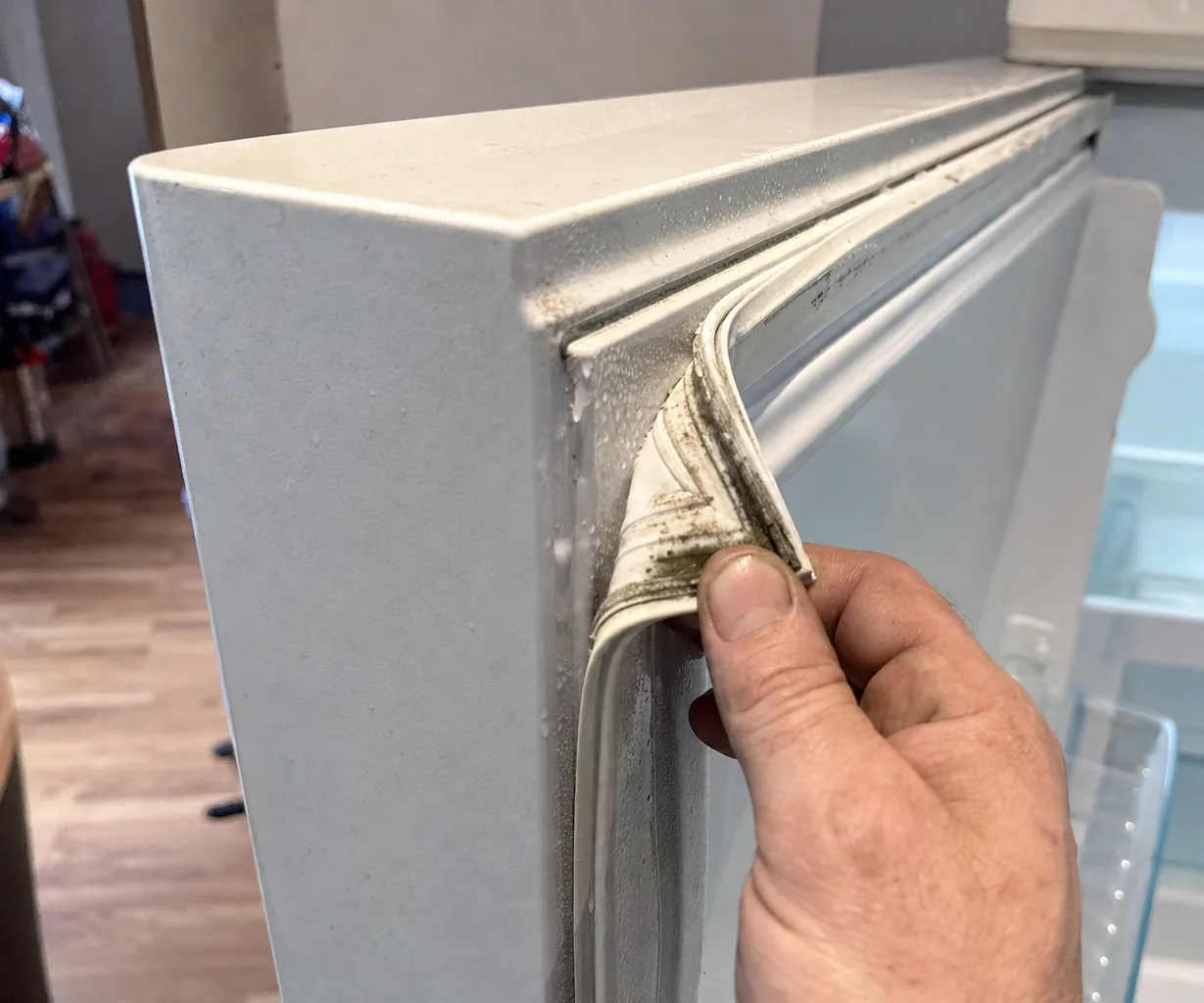
Humidity next. Gaskets in this climate harden and take a set sooner than they do inland, and the first sign is almost never a temperature complaint — it is frost coming back on the freezer’s back wall, or condensation on the cabinet face around the door.
Then the ordinary things: a condenser choked with dust and pet hair behind the upper grille, an evaporator fan on its way out, a drain line that has closed up and put water under the crisper drawers.
Eagle Harbor is our home ground and there is no travel story to tell about it. We work weekdays from eight and Saturday mornings, we bring the common wear parts for the units of this vintage, and if the fix needs a part we do not have, you get the finding and the price in writing before anything is ordered. The diagnostic is a flat fee, credited toward the repair.
The same book as everywhere else we drive. The flat visit fee covers the diagnosis in Eagle Harbor, and the repair itself lands in one of the bands below.
| Work | Typical range |
|---|---|
| $80 diagnostic visit | $80 |
| Door gasket or seal replacement | $250–$650 |
| Evaporator or condenser fan motor | $250–$600 |
| Defrost heater, thermostat or sensor | $260–$630 |
| Ice maker, water valve or supply line | $250–$620 |
| Electronic control board | $420–$840 |
| Compressor or sealed-system repair | $870–$2,460 |
Ranges, not quotes: the firm figure is written down after the diagnosis and nothing is ordered or billed until you have approved it. On this page the work we describe runs from $80 for the visit to about $2,460 at the top of the band above. The whole book of bands is on the pricing page.
We do not service heating or air conditioning. No furnaces, no heat pumps, no air handlers, no mini-splits and no ductwork. That is a separate trade with its own licensing, and a call about a house that will not cool belongs with an HVAC contractor rather than with us. In Eagle Harbor as everywhere else we drive, the work is the cold box and nothing around it.
Working hours: Monday – Friday 8:00am – 6:00pm; Saturday 9:00am – 4:00pm. Roughly 40 miles from Fleming Island.
4.3 out of 5 across 62 customer reviews. Read every one of them.
The unit was running non stop and never quite reaching its setting. He weighed in the charge properly after the repair instead of guessing on gauge pressure, which the last firm did not bother with.
Alaric M.2026-06-27
The seal had gone hard along the top and the cabinet face was damp every afternoon. New gasket, hinge shimmed, closer reset, and the paper test held everywhere he tried it before he packed up.
Verity N.2026-08-08
The glass door fogged every humid afternoon and water was collecting on the lowest rack. The catch had gone out of adjustment so the door never drew fully in. He set it and fitted a new seal.
Sorrel J.2026-09-01