Our refrigerator column was running far longer than it used to. He cleaned a condenser loaded with pollen and oak litter, then rechecked the compartment with a probe instead of reading the front display.
Horace K.2026-09-09
Independent Sub-Zero specialists · Fleming Island, Clay County
Monday – Friday 8:00am – 6:00pm Call (904) 201-3304
Single-purpose refrigerator, freezer and wine columns that hide completely behind cabinet panels — one box warm, one still cold, and no visible grille to check.
A column hides its grille behind the joinery. Half the diagnosis is finding out where its air is supposed to go.
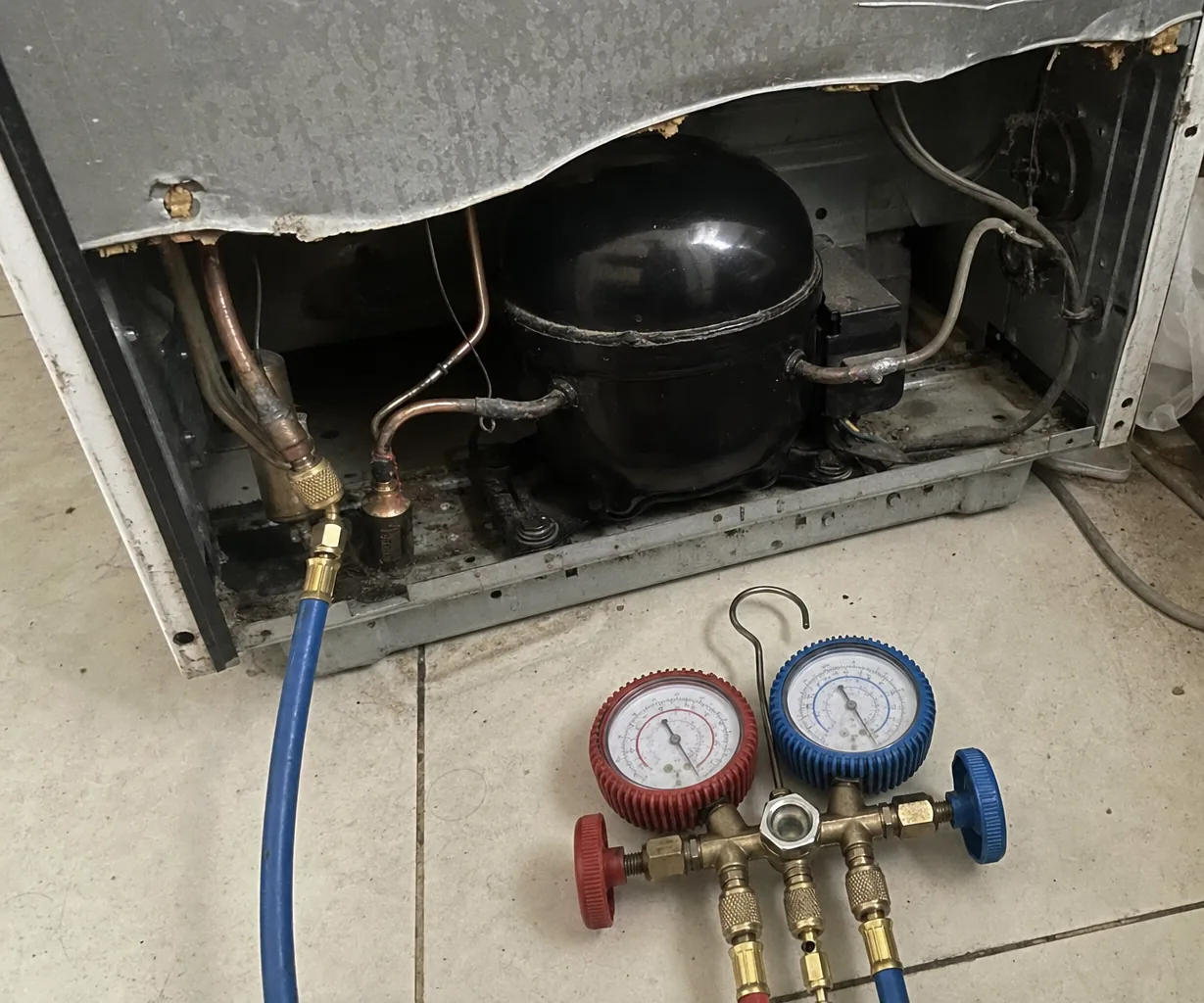
A column is a single-purpose box. One unit refrigerates, another freezes, another holds wine, and each has its own sealed system, its own controls and its own door. Installed side by side behind matching cabinet panels, they read as one run of joinery. That is the point of them, and it is also the reason they are diagnosed differently from a conventional built-in.
The single most common call on a column pair is that the refrigerator side has gone warm while the freezer beside it is holding perfectly. Owners hear that and assume the whole installation is on its way out. It usually is not. The units are mechanically independent, so a warm refrigerator column tells you the fault is inside that cabinet — its evaporator fan, its defrost cycle, its control board, its air path — and says nothing at all about the one next to it.
That independence cuts both ways. It means a column can be repaired without touching its neighbour, and it means a shared symptom across both columns points somewhere outside the appliances: the circuit they are on, the ambient temperature of the room, or the cabinetry itself.
A built-in with an exposed upper grille tells you where its condenser breathes. A fully integrated column does not. The intake and discharge are concealed behind the panel work, and how much clearance the installer actually left is the first thing we want to know. We have opened columns where the toe-kick opening was reduced by a later floor, and columns where a cabinet return was added across the top of the run during a remodel and quietly halved the exhaust path.
The symptom in both cases is the same and it is unspectacular: the unit runs longer, holds a degree or two warmer than it should on hot afternoons, and never quite recovers after the door has been open. Nothing has broken. The kitchen changed around the appliance.
We measure the opening, check what the air is doing, and clean the condenser before we call anything a failure. On a column that has been in service ten years in a house with pets, that step alone sometimes ends the visit.
Column doors carry a full-height custom panel, and a full-height panel is heavy. The hinge and closer system is set up for that weight, and it goes out of adjustment slowly enough that nobody notices until the door stops pulling itself closed over the last inch. Once it stops sealing, warm air gets in, and in a Clay County summer that shows up as frost inside the freezer column, sweating on the panel face, or a refrigerator that runs constantly without ever feeling cold.
Adjusting a column door is fiddly work. The panel has to sit flush with the cabinetry on both sides of it, the gap has to stay even top to bottom, and the seal has to make contact around the whole perimeter. It is worth doing properly rather than shimming until it closes.
A freezer column with an ice maker has a fill valve, a mould and a supply line running to it, and on a column that line is frequently threaded through a cabinet base that was closed up after installation. That routing is the first thing we look at, because a column has to come forward to be serviced and a line with no service loop gets pinched on the way back in.
From there the order is the cheap findings first: the shut-off arm or bin sensor that tells the unit it is already full, the inlet valve solenoid, the mould heater and harvest motor, and only then the control. A column ice maker also depends on the compartment around it, so a freezer column running a few degrees warm will present as an ice problem long before anyone calls it a temperature problem.
We start with a flat diagnostic that is credited toward the repair if you go ahead. You get the finding and the cost in writing before any part is ordered. Parts are genuine OEM, labour is warranted for 90 days and parts for 365, and sealed-system work is carried out by technicians holding EPA Section 608 certification for refrigerant handling.
If a column has to come out of its opening to be worked on, we tell you that before we start, and we agree on how the panel comes off first.
These are the bands this kind of fault lands in once it is diagnosed, parts and labour together. The visit comes off whichever line the job turns out to be.
| Work | Typical range |
|---|---|
| $80 diagnostic visit | $80 |
| Electronic control board | $420–$840 |
| Evaporator or condenser fan motor | $250–$600 |
| Defrost heater, thermostat or sensor | $260–$630 |
| Door gasket or seal replacement | $250–$650 |
Ranges, not quotes: the firm figure is written down after the diagnosis and nothing is ordered or billed until you have approved it. On this page the work we describe runs from $80 for the visit to about $840 at the top of the band above. The whole book of bands is on the pricing page.
A flat $80 covers the visit and the diagnosis. It is credited toward the repair if you go ahead with the work.
Labour is warranted for 90 days and parts for 365 days from the date of the repair. Genuine OEM parts throughout.
We service Sub-Zero refrigeration only, as an independent shop. We do not service heating or air conditioning. No furnaces, no heat pumps, no air handlers, no mini-splits and no ductwork. That is a separate trade with its own licensing, and a call about a house that will not cool belongs with an HVAC contractor rather than with us.
4.3 out of 5 across 62 customer reviews. Read every one of them.
Our refrigerator column was running far longer than it used to. He cleaned a condenser loaded with pollen and oak litter, then rechecked the compartment with a probe instead of reading the front display.
Horace K.2026-09-09
The panel front had stopped sitting flush and the column was working harder for it. He reset the hinge shims, adjusted the closer and the seal now pulls in evenly along its whole length.
Serena F.2026-07-22
Our refrigerator column had ice forming behind the rear panel every few weeks. He melted it down, found the defrost heater open at one end, and checked the drain would clear before he packed up.
Barnaby W.2025-11-22