The repair holds and the cabinet is quiet again. What I did not care for was being told the part would arrive at the start of the week and then hearing nothing at all until I chased it myself.
Marcus O.2026-08-06
Independent Sub-Zero specialists · Fleming Island, Clay County
Monday – Friday 8:00am – 6:00pm Call (904) 201-3304
Northeast Florida sees around sixty-eight thunderstorm days a year. What that does to a Sub-Zero control board, and how to tell a surge from a failed part.
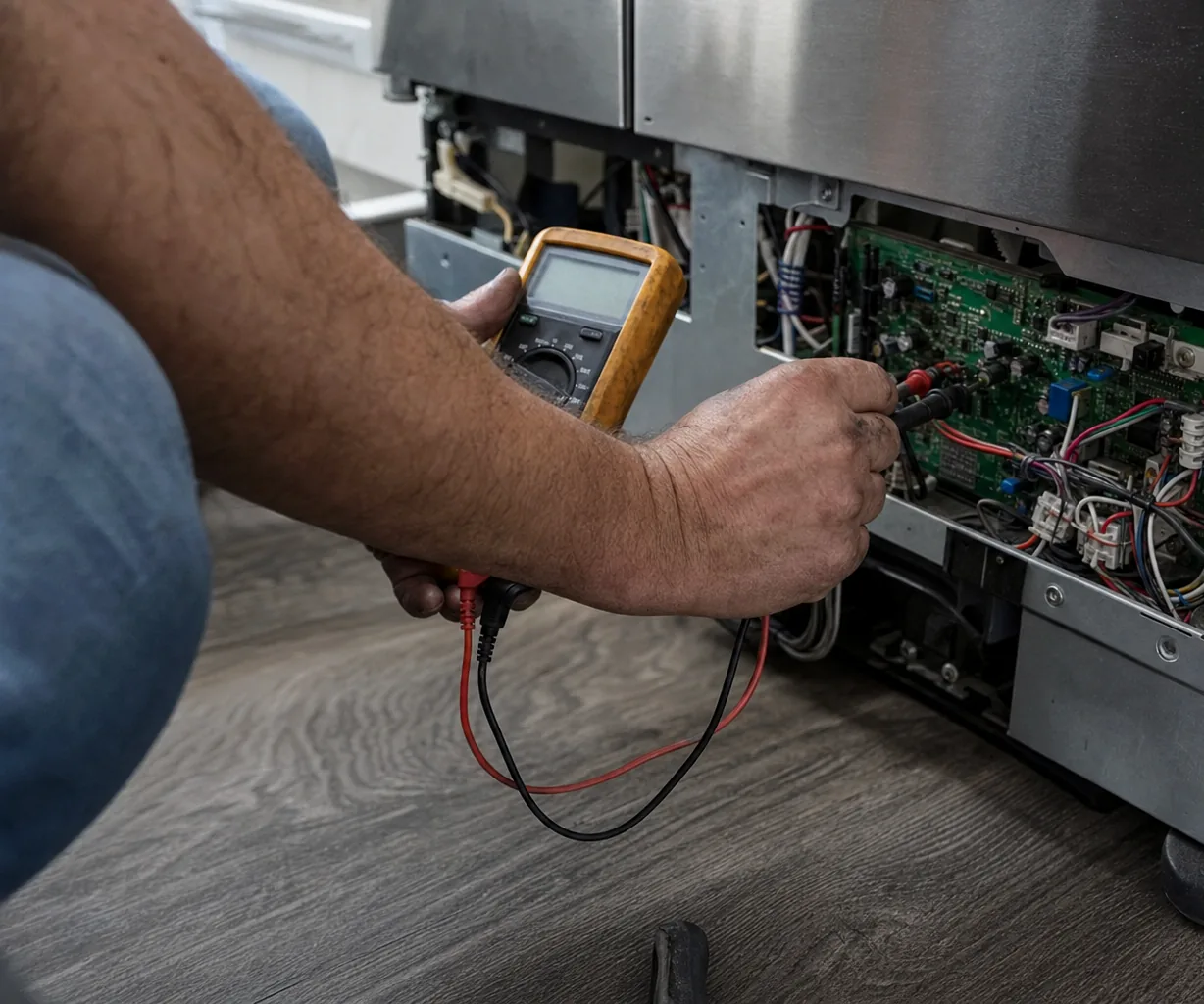
June through September, the pattern of calls changes. Units that were fine at lunchtime are unresponsive by evening. Displays are blank. A compressor hums, clicks and gives up. Almost all of it lands within a day or two of a bad afternoon of weather.
Northeast Florida runs something in the order of sixty-eight thunderstorm days in an average year. That is the background condition every appliance in this county lives with, and refrigeration electronics are not indifferent to it.
Not usually a direct strike. Direct strikes destroy far more than a refrigerator, and when one happens nobody is confused about the cause.
The ordinary damage comes from what surrounds a storm. A voltage spike induced on the line when protective equipment operates somewhere on the circuit. A brownout, where voltage sags rather than fails, and motors draw hard against it. And the worst of the three, a rapid sequence of interruptions — power out, back, out again in a few seconds — which is much harder on a compressor and its start components than a clean outage of an hour.
That last case is why a unit can survive a hurricane with the power off for two days and then fail during an ordinary June squall.
A few patterns are worth knowing before you call anyone.
Blank display, no lights, nothing at all. Check the breaker first, then the outlet, then whether the unit is on a shared circuit that tripped a GFCI somewhere else. It happens more often than it should in older kitchens.
Display alive, unit cold, but a function has stopped — ice maker dead, one compartment not cycling, a fan not running. That points at a specific circuit or component rather than the whole board.
Display alive, unit warming, compressor humming and clicking every few minutes. That is a start-component or relay pattern far more often than it is a dead compressor. It is a comparatively small repair and it deserves to be ruled out before anyone quotes sealed-system work.
Everything works but the settings have reset themselves or the temperature displayed does not match reality. That is often a control that took a hit and survived imperfectly, or a sensor that did.
Leave the doors shut. A well-insulated built-in will hold food safely for several hours if nobody opens it, and every opening costs you time you may need.
If the power has been unstable rather than off, it is reasonable to pull the appliance’s power for a full minute and restore it once, cleanly. That resolves a small number of cases where a control has latched into a fault state. Doing it repeatedly does not help and short-cycling a compressor makes things worse.
Do not put a refrigerator on an extension cord or a small consumer surge strip as a fix. The starting current is not what those are designed for.
Refrigeration circuits in Clay County houses are rarely surge-protected as built, and a built-in represents a great deal more money than the protection costs. There are two levels worth discussing with an electrician: a whole-house device at the panel, which handles what arrives from outside, and a properly rated point-of-use device at the appliance for what is generated inside the house.
We are a repair company and not an electrical contractor, so treat that as context rather than a quote. But after enough June visits to the same streets, it is the piece of advice we give most often.
Control boards are expensive and they are also the easiest thing in the appliance to blame. Before we replace one we measure the supply voltage under load, check the components the board drives, and confirm the board is failing rather than reporting somebody else’s failure. On older kitchens — Orange Park retrofits especially, where a built-in may share a circuit with a countertop load — a board that appears intermittently faulty is sometimes a perfectly good board being starved.
You get the finding in writing before a part is ordered, along with what it costs and what it does not fix.
The bands below are the ones this note is about. They are completed repairs, parts and labour together, on top of a flat diagnostic visit that is credited toward the work.
| Work | Typical range |
|---|---|
| $80 diagnostic visit | $80 |
| Electronic control board | $420–$840 |
Ranges, not quotes: the firm figure is written down after the diagnosis and nothing is ordered or billed until you have approved it. On this page the work we describe runs from $80 for the visit to about $840 at the top of the band above. The whole book of bands is on the pricing page.
A flat $80 covers the visit and the diagnosis. It is credited toward the repair if you go ahead with the work.
4.3 out of 5 across 62 customer reviews. Read every one of them.
The repair holds and the cabinet is quiet again. What I did not care for was being told the part would arrive at the start of the week and then hearing nothing at all until I chased it myself.
Marcus O.2026-08-06
Meltwater kept appearing at the base of the unit. He traced it to a drain line blocked where it leaves the liner, flushed it and refitted the clip that keeps the heat loop against the tube.
Marguerite D.2026-03-14
Condenser was solid with dust from a remodel. He cleaned it, rechecked the current the fan was drawing, and was honest that with the cabinet boxed in this tightly it will need doing again before long.
Vance P.2026-02-01