Cabinet ran without ever getting down to its setting. Before touching the sealed side he cleared a silted condenser and rechecked, which changed nothing, so the diagnosis was earned rather than assumed.
Cassius D.2026-08-29
Independent Sub-Zero specialists · Fleming Island, Clay County
Monday – Friday 8:00am – 6:00pm Call (904) 201-3304
A Sub-Zero refrigerator compressor that hums and cycles on and off is normal; grinding, rattling or a hum that never stops while food warms needs a technician.
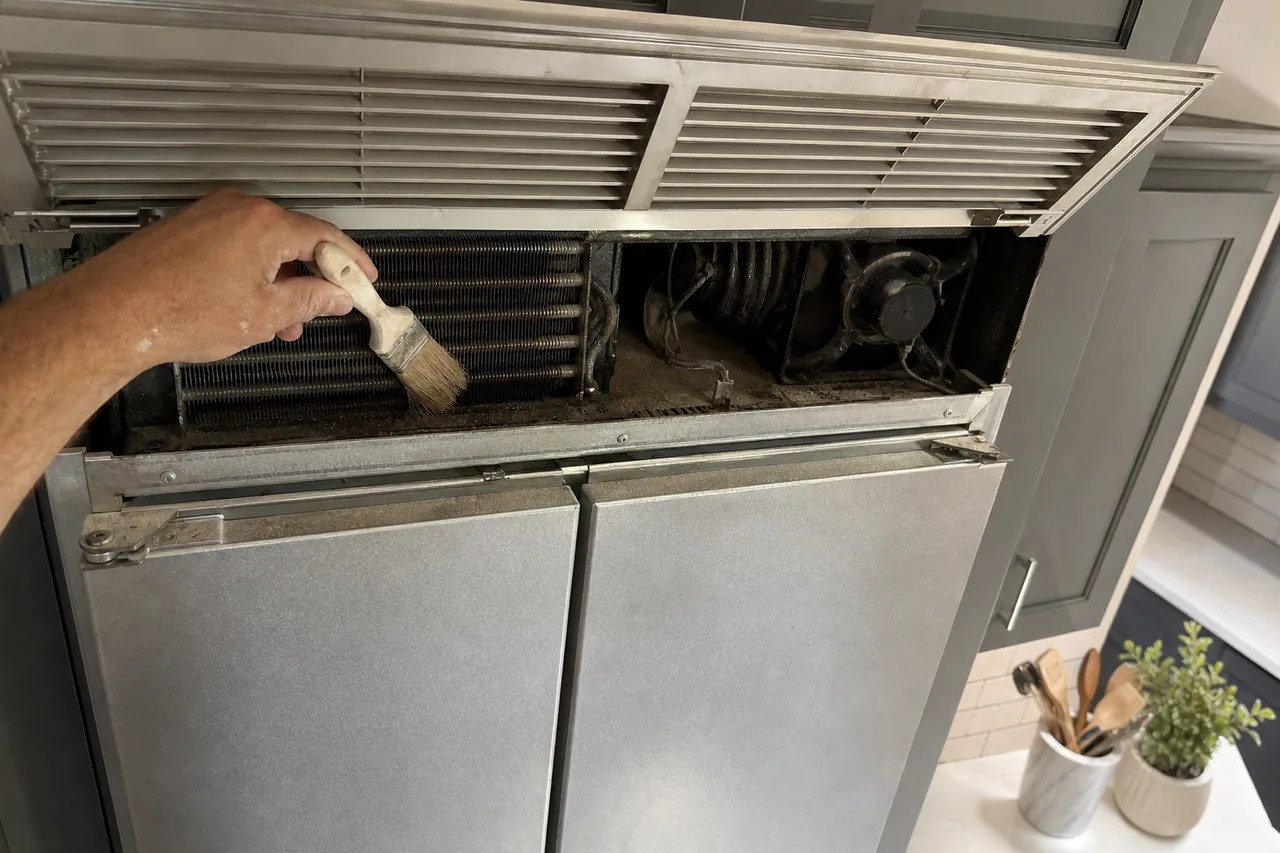
Most compressor noise from a Sub-Zero refrigerator is normal. A healthy unit gives off a low, even hum from the machine compartment, runs for a while, then goes quiet, often with a soft click at each end of the cycle. The sounds worth acting on are different: a hum that never stops while the food gets warmer, a metal-on-metal rattle, a scraping or squealing fan, or a buzz, click and silence that repeats every few minutes. Most of those trace back to a dusty condenser or a tired fan motor, and a smaller share to the sealed system itself.
Long runs are expected after a big grocery restock, after a door has stood open, or on a muggy afternoon when the kitchen is warmer than usual. The compressor is catching up, and its cycles shorten again once the cabinet settles.
Several other noises come from parts near the compressor and are easy to blame on it:
If you recently switched on Max Ice, expect extra activity. Sub-Zero notes that the feature lifts ice output by as much as 30% across a 24-hour window, and some parts run faster and sound different until it ends. On Classic (BI) panels, three ice cube icons show it is active.
A compressor that hums without ever cycling off is the most common complaint. Usual causes are a condenser packed with dust, a condenser fan that has slowed or quit, or a leaky door gasket that keeps the system chasing a temperature it cannot reach. Less often, a refrigerant leak or a worn compressor leaves it running flat out with little cooling to show for it.
Scraping or chirping inside the freezer usually means the evaporator fan blade is striking frost, which hints at a defrost problem, or that the motor bearings are wearing out. Squealing from the top grille is the same story for the condenser fan.
Take one pattern seriously right away: a buzz from the machine compartment, a click, then silence, repeating every few minutes while the cabinet warms. That is the compressor failing to start and its overload switch cutting it off, and each failed attempt adds heat to the motor.
Newer panels often flag an overworked compressor before you hear it. EC50 with Service flashing means the refrigerator compressor has been running too long. If temperatures read close to normal, clean the condenser, then hold the bell key, the door-ajar alarm button, for 15 seconds to clear it. If temperatures are high, skip the reset and book service.
EC40 is the freezer counterpart, seen on units such as the 648PRO. Behind it may be an open door, a weak fan, a faulty temperature sensor or trouble in the sealed system. A freezer reading within 10° of its setting usually just wants a condenser cleaning. Once it climbs past 10° over setting with every door shut, book a technician, and resist clearing the code again while the numbers keep rising.
If the word Service flashes between the two zone readings, the cause is again excessive compressor run. With near-normal temperatures, clean the condenser and turn the home breaker off for 30 seconds.
On Classic (CL) models the condenser hides behind the flip-up grille at the top. On Designer (DET, DEC) units it sits behind the kickplate, held by two screws. Switch the unit off at its control panel, wear gloves, and vacuum with a soft brush, stroking along the fins so they stay straight.
Two limits apply. A refrigerator under 6 months old should not need this yet. And if the fresh-food side reads above 48 degrees while set at 38, a cleaning is unlikely to bring it back, so call instead of waiting. Homes with dogs or cats clog the coil faster, since the fan pulls loose hair straight in.
A visit starts with an $80 diagnostic, and the firm price follows once the cause is found. As a typical range, a fan motor runs $250–$600 and an ice maker or water valve $250–$620. Compressor or other sealed-system work is typically $870–$2,460, the point where it pays to weigh whether the unit merits repair. Long-running and warm-cabinet symptoms are covered on our sealed-system page.
Hibernia Cold Systems is an independent shop that fits genuine OEM parts, working around Fleming Island, Doctors Lake and Orange Park. When you call, describe the sound, when it happens, what the display shows and the current temperatures.
The bands below are the ones this note is about. They are completed repairs, parts and labour together, on top of a flat diagnostic visit that is credited toward the work.
| Work | Typical range |
|---|---|
| $80 diagnostic visit | $80 |
| Door gasket or seal replacement | $250–$650 |
| Evaporator or condenser fan motor | $250–$600 |
| Defrost heater, thermostat or sensor | $260–$630 |
| Ice maker, water valve or supply line | $250–$620 |
Ranges, not quotes: the firm figure is written down after the diagnosis and nothing is ordered or billed until you have approved it. On this page the work we describe runs from $80 for the visit to about $650 at the top of the band above. The whole book of bands is on the pricing page.
A flat $80 covers the visit and the diagnosis. It is credited toward the repair if you go ahead with the work.
4.3 out of 5 across 62 customer reviews. Read every one of them.
Cabinet ran without ever getting down to its setting. Before touching the sealed side he cleared a silted condenser and rechecked, which changed nothing, so the diagnosis was earned rather than assumed.
Cassius D.2026-08-29
The unit was running non stop and never quite reaching its setting. He weighed in the charge properly after the repair instead of guessing on gauge pressure, which the last firm did not bother with.
Alaric M.2026-06-27
He told us plainly that on a cabinet this old the sealed work was worth doing only because the rest of it was sound, and that he would have said otherwise if the liner had been cracked.
Nerissa J.2026-04-03